AI Series · 18
AI Is Consuming More Power Than Countries
Training and running AI at scale now demands gigawatts most people never think about — and the industry stays quiet on it.
On this page5 sections
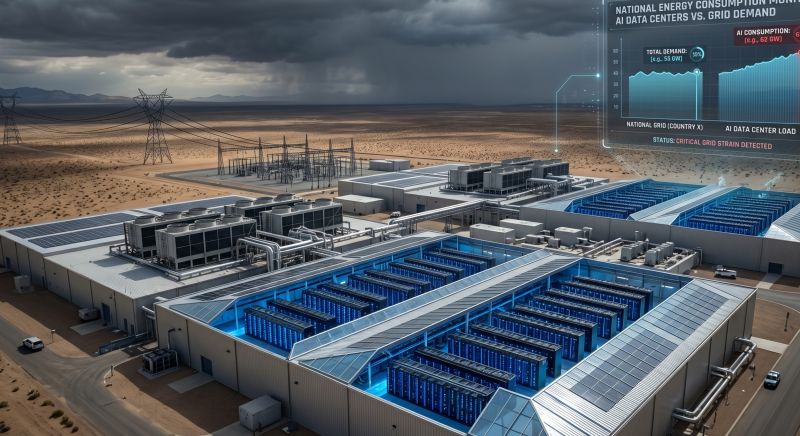
Training GPT-4 consumed roughly the same electricity as 1,000 US homes use in a year. GPT-6 is estimated to have consumed multiples of that. And AI inference — running queries at scale, billions of times daily — dwarfs training in total energy demand.
Over 100 gigawatts of AI data center capacity is currently planned or under construction globally. For context: that is roughly 10% of total US electricity generation capacity.
AI has become one of the fastest-growing energy consumers in human history. And the industry is mostly silent about it.
Data Centers Are Now Reshaping National Energy Strategies
Saudi Arabia, the UAE, and the US are all accelerating power grid investments specifically to attract AI infrastructure. The GCC is positioning itself as a global AI data center hub, leveraging cheap land, political stability, and significant energy capacity. AI infrastructure location decisions are now geopolitical decisions.
The Compute War Is Also an Energy War
The lab that controls the most compute wins the model race. But compute requires power, and power supply is physically constrained. OpenAI, Microsoft, and Google are all signing decade-long power purchase agreements with nuclear, solar, and gas providers. Controlling energy contracts is now a frontier AI strategy.
The Carbon Cost Is the Uncomfortable Truth the Industry Avoids
AI labs publish benchmark results, safety reports, and funding announcements. Very few publish energy consumption data. The gap between AI's sustainability claims and its actual energy footprint is significant, and growing. This will become a regulatory issue within 24 months.
Smaller Models Are the Efficiency Answer — But Not Yet the Scale Answer
Research into model compression and efficient architectures is advancing rapidly. Some models now achieve 80% of GPT-6 performance at 10% of the compute cost. But frontier capability still requires frontier compute. Efficiency gains are real. They are not yet fast enough to offset the overall demand surge.
The Regions That Solve the Energy Problem Will Win the AI Infrastructure Race
The next decade of AI leadership will not be determined only by model quality. It will be determined by who can power the compute at scale, reliably, at acceptable cost. This makes energy policy and AI policy inseparable.
Bottom line: AI is not just a software story. It is an infrastructure and energy story. Every company building on AI is implicitly dependent on a global power supply chain. The leaders who understand this are already planning for it. Most are not.
AI Series continues.
Originally published on LinkedIn.
Read the series — AI Series
AI Series index- 01AI Gives Everyone New Opportunities
- 02What AI Really Is
- 03The Power of Prompts
- 04Prompt Structure and Real Examples
- 05How to Pick the Right AI Tool
- 06Combine AI Tools Like a Digital Team
- 07Build Your Own AI System (No Coding Needed)
- 08Think Like AI
- 09Staying Updated in AI
- 10The Future of AI and How It Changes Our Work
- 11How Small Businesses and Freelancers Can Use AI
- 12From ML to Agents: How AI Actually Evolved
- 13Build a Website for Free Using AI (Zero Experience Needed)
- 14GPT-6 Just Landed. The Model War Isn't About Chatbots
- 15AI Agents Are Taking Over Enterprise Workflows
- 16$242 Billion Went Into AI in One Quarter
- 17AI Now Performs at Expert Level in 44 Professions
- 18AI Is Consuming More Power Than Countries (this piece)
- 19From "I Need A Website" To "My Website Is Live" With AI

Muhammed Nasvih V
Lead DevOps & Cloud Engineer · Jeddah, Saudi Arabia
Writes The Stack Notes — field notes on infrastructure, AI, money and work. Cloud infrastructure, CI/CD, security and automation at Code7 Information Technology.