AI Series · 12
From ML to Agents: How AI Actually Evolved
AI did not arrive overnight. It evolved quietly through seven overlapping phases, then suddenly accelerated.
On this page9 sections
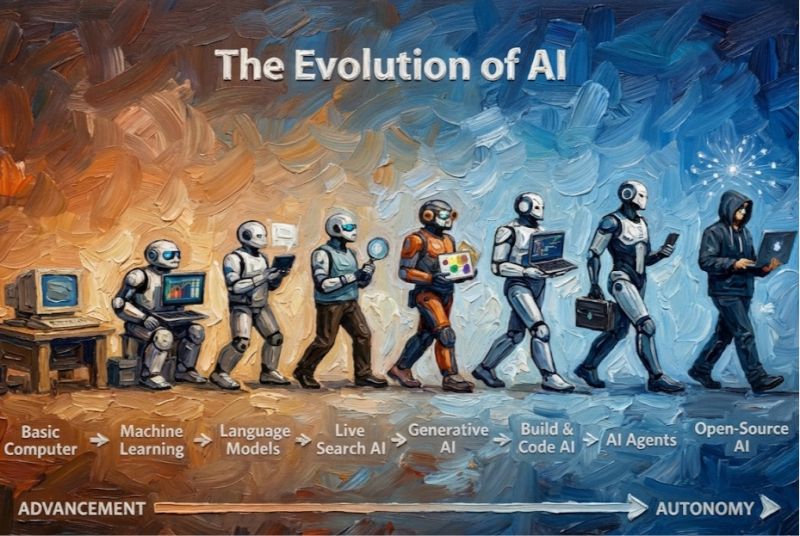
AI didn't arrive overnight. It evolved quietly, then suddenly accelerated. Here is the real progression, without hype. These phases overlap, but each marks a major capability shift.
Phase 1: Machine Learning — Pattern Machines
Early AI was machine learning. It learned from data but couldn't think or talk. Real examples: Gmail spam filters, Netflix recommendations, credit score prediction. The rule: data in, pattern out. Useful, but narrow.
Phase 2: Large Language Models — Language at Scale
Then came LLMs. Machines started understanding and generating human language. Real tools: ChatGPT, Claude, Gemini. New abilities: explain concepts, summarize information, perform multi-step reasoning tasks. This is when AI became usable for everyone, not just engineers.
Phase 3: AI + Live Search — Real-Time Knowledge
LLMs were smart but time-limited, so AI learned to access live information. Real tools: ChatGPT with browsing, Perplexity, Gemini Search. Now AI could answer current questions, compare options, and analyze ongoing trends. AI shifted from chatbot to assistant.
Phase 4: Generative AI — Creation, Not Just Answers
AI started creating, not just responding. Real tools: Midjourney (images), DALL·E and Firefly (design), Runway (video). Impact: design speed exploded, creativity became accessible, solo creators gained leverage.
Phase 5: AI for Building Things — Execution Barriers Drop
This is where building became easier. AI began co-building products with humans. Real tools: Lovable.dev for full websites, Bolt and Framer AI for landing pages, GitHub Copilot and Cursor for code.
You don't need to know everything. You need to know what to ask.
Phase 6: AI Agents — Partial Delegation
This is the current shift. AI doesn't just respond, it can act within workflows. Real examples: browser agents (AutoGPT-style, Comet-like tools) that can research, navigate websites, fill forms, and repeat tasks. This is moving from assistance toward delegation, with humans still in the loop.
Phase 7: Open-Source AI — Power Spreads
AI capability is no longer locked. Real examples: LLaMA, Mistral, local AI setups. Anyone can customize models, build agents, and innovate faster. This is why progress feels chaotic.
Why AI Feels Exponential
Because AI accelerates the tools humans use to improve AI. The loop: AI → better tools → faster development → stronger AI → repeat. That's why timelines keep breaking.
Final Thought
AI isn't a trend. It's a platform shift — like the internet or smartphones. The skill now isn't memorization. It's adaptation and clear thinking.
I'll keep sharing what I learn — practical, honest, no hype.
Originally published on LinkedIn.
Read the series — AI Series
AI Series index- 01AI Gives Everyone New Opportunities
- 02What AI Really Is
- 03The Power of Prompts
- 04Prompt Structure and Real Examples
- 05How to Pick the Right AI Tool
- 06Combine AI Tools Like a Digital Team
- 07Build Your Own AI System (No Coding Needed)
- 08Think Like AI
- 09Staying Updated in AI
- 10The Future of AI and How It Changes Our Work
- 11How Small Businesses and Freelancers Can Use AI
- 12From ML to Agents: How AI Actually Evolved (this piece)
- 13Build a Website for Free Using AI (Zero Experience Needed)
- 14GPT-6 Just Landed. The Model War Isn't About Chatbots
- 15AI Agents Are Taking Over Enterprise Workflows
- 16$242 Billion Went Into AI in One Quarter
- 17AI Now Performs at Expert Level in 44 Professions
- 18AI Is Consuming More Power Than Countries
- 19From "I Need A Website" To "My Website Is Live" With AI

Muhammed Nasvih V
Lead DevOps & Cloud Engineer · Jeddah, Saudi Arabia
Writes The Stack Notes — field notes on infrastructure, AI, money and work. Cloud infrastructure, CI/CD, security and automation at Code7 Information Technology.