Tech Series · 08
AI Is Inside Your Pipeline. Most Teams Run It Wrong.
AI didn't just change what software does. It changed how software is built, tested, deployed, and monitored.
On this page5 sections
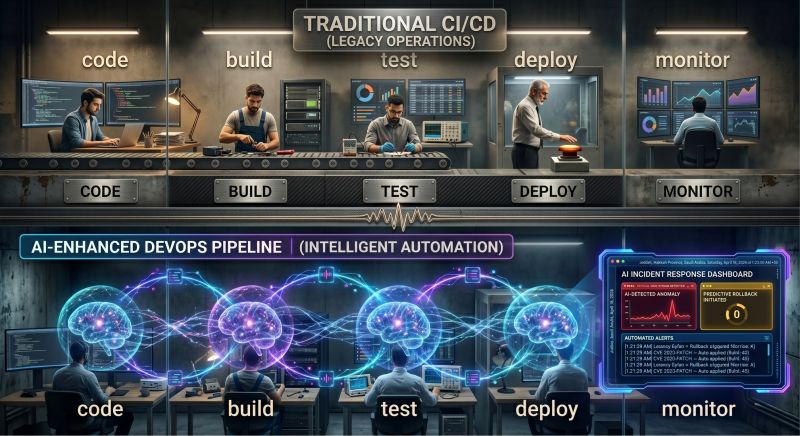
AI didn't just change what software does. It changed how software is built, tested, deployed, and monitored.
Most DevOps teams are still treating AI tools like they treated Slack in 2014 — informally, no governance, no standards, no strategy.
Here is what is actually happening in production engineering right now.
AI Is Already In Your CI/CD Pipeline — Planned Or Not
GitHub Copilot and Cursor write code that goes into pull requests, gets reviewed, merged, and deployed. If your code review process has no standard for AI-generated code, you are already running blind.
AI-Assisted Incident Response Is Compressing MTTR Dramatically
With AI integrated into observability platforms like Datadog AI and AWS DevOps Guru: an alert fires, AI correlates anomalies across services automatically, suggests a root cause with a confidence score, and an engineer validates and acts. MTTR that took 45 minutes is dropping to under 10.
AI Is Writing IaC — And the Blast Radius of a Wrong Suggestion Is Massive
Copilot can write Terraform, Helm charts, and Kubernetes manifests. A developer can generate and apply IaC in minutes with no deep infrastructure knowledge. AI doesn't know your security policies, network topology, or compliance requirements. AI accelerates IaC authoring. Human expertise is still what makes it safe.
Deployments Are Becoming Self-Governing
Tools like Argo Rollouts and Flagger monitor deployment health in real time — error rate, latency, saturation — and automatically adjust traffic or trigger rollback without human input. The DevOps engineer's job is now defining the rules the AI enforces.
The DevOps Engineer of 2026 Needs a New Skill Layer
Not a replacement. An addition:
- Prompt AI tools to generate infrastructure safely
- Validate AI-generated code before merge
- Configure observability thresholds that reflect real business risk
- Govern AI tool usage across the engineering org
Engineers who treat AI as a tool they control — not a shortcut they depend on — are the ones production trusts.
Bottom line: AI is not replacing DevOps. It is raising the floor for what DevOps engineers must manage. The pipeline is smarter. The blast radius of mistakes is larger. Understanding AI in the operational layer is no longer optional. It is the job.
This series continues.
Originally published on LinkedIn.
Read the series — Tech Series
Tech Series index- 01Why DevOps (And What It Really Is)
- 02Zero to 100: Servers, Cloud, and Networking Foundations
- 03Cloud Under Fire: What Every Tech Leader Must Learn
- 04Why Big Tech Companies Still Go Down
- 05The Silent War Happening Inside Every Tech Company
- 06The Internet Was Never Designed to Be This Big
- 07Why the World's Most Expensive Software Keeps Failing
- 08AI Is Inside Your Pipeline. Most Teams Run It Wrong. (this piece)
- 09The Japanese WordPress Hack: Zero To 100
- 10VPN: What It Is, Who It's Actually For
- 11Why "Full-Stack" Stopped Being Optional
- 13What Is System Design And Why You Should Care

Muhammed Nasvih V
Lead DevOps & Cloud Engineer · Jeddah, Saudi Arabia
Writes The Stack Notes — field notes on infrastructure, AI, money and work. Cloud infrastructure, CI/CD, security and automation at Code7 Information Technology.