Tech Series · 07
Why the World's Most Expensive Software Keeps Failing
A single reused line of code destroyed a $370 million rocket. That pattern never really stopped.
On this page5 sections
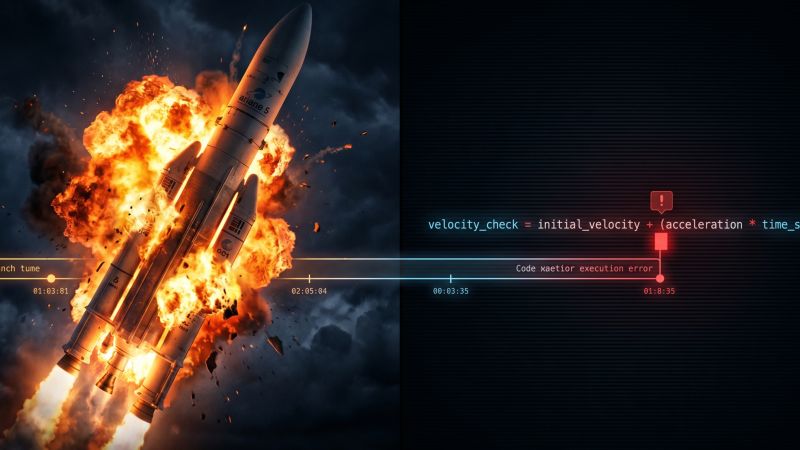
In 1996, the Ariane 5 rocket exploded 37 seconds after launch. Cause: a 64-bit number was converted into a 16-bit integer. A single line of reused code — that worked perfectly for a decade — caused a $370 million rocket to destroy itself.
This is not ancient history. It repeats constantly.
Software Does Not Degrade. But the World Around It Does.
Code written in 2005 still runs in 2026. But the systems, users, and threats around it have completely changed. The code is the same. The context is unrecognizable. This is software rot — and it affects every long-running system on earth.
Complexity Is Invisible Until It Breaks
Global banking, healthcare, and aviation software is not one system. It is thousands of patches and legacy integrations stacked over decades. No single person understands it entirely. When it breaks, nobody knows why — because nobody fully knows what it is.
Testing Cannot Simulate Reality
You test every scenario you can imagine. Reality produces one you did not. The 2003 Northeast blackout — 55 million people without power — began with an alarm system that silently failed. The failure was in code nobody tested because nobody imagined that scenario.
Tech Debt Is Silent — Until It Is Catastrophic
Every "we'll fix it later" accumulates. The 2017 British Airways failure that stranded 75,000 passengers? A contractor powered down a data center component in a system with no recovery procedure — because nobody had written one.
The Engineers Leave. The Knowledge Leaves With Them.
The most dangerous software is software nobody fully understands anymore. This is why COBOL — written in the 1960s — still processes $3 trillion in daily transactions. Because nobody wants to touch what they do not understand.
Bottom line: Software fails not because engineers are careless. It fails because complex systems cannot be fully understood or fully tested. The answer is not perfect code. It is observability, redundancy, and the humility to treat failure as a certainty, not an edge case.
Part 8 picks this up: AI is now inside your pipeline.
Originally published on LinkedIn.
Read the series — Tech Series
Tech Series index- 01Why DevOps (And What It Really Is)
- 02Zero to 100: Servers, Cloud, and Networking Foundations
- 03Cloud Under Fire: What Every Tech Leader Must Learn
- 04Why Big Tech Companies Still Go Down
- 05The Silent War Happening Inside Every Tech Company
- 06The Internet Was Never Designed to Be This Big
- 07Why the World's Most Expensive Software Keeps Failing (this piece)
- 08AI Is Inside Your Pipeline. Most Teams Run It Wrong.
- 09The Japanese WordPress Hack: Zero To 100
- 10VPN: What It Is, Who It's Actually For
- 11Why "Full-Stack" Stopped Being Optional
- 13What Is System Design And Why You Should Care

Muhammed Nasvih V
Lead DevOps & Cloud Engineer · Jeddah, Saudi Arabia
Writes The Stack Notes — field notes on infrastructure, AI, money and work. Cloud infrastructure, CI/CD, security and automation at Code7 Information Technology.