Tech Series · 03
Cloud Under Fire: What Every Tech Leader Must Learn
An AWS data center in the UAE was reportedly hit during regional strikes. When physical conflict can take out a cloud region, the risk model changes.
On this page6 sections
This isn't theory anymore.
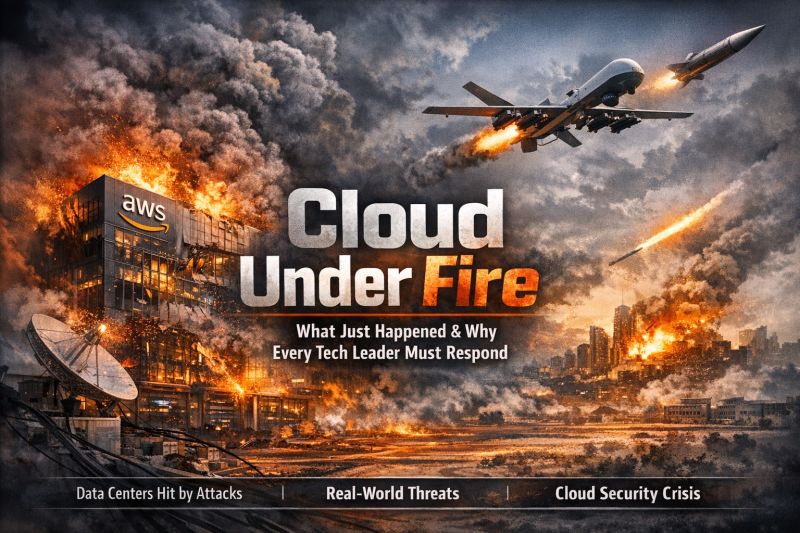
Earlier today, an AWS data center in the UAE was reportedly impacted during regional strikes, forcing emergency shutdowns and service disruption across at least one availability zone. Power was cut to control a fire after objects struck the facility, and connectivity issues were also reported at infrastructure in Bahrain. At the same time, geopolitical tensions between Iran and GCC partners continue escalating with missile and drone attacks.
If confirmed at scale, this would mark one of the clearest examples of a major cloud provider's physical infrastructure being affected during active conflict — not by software bugs, not by phishing, not by routine outages, but by real-world kinetic events.
Here's what every tech leader needs to understand.
The Cloud Is Physical, and Vulnerable
We talk about AWS, Azure, and GCP like they are abstract. They're not. They live in buildings filled with hardware, shared power grids, cooling systems, and fiber lines — all of which can be affected by geopolitical conflict. If a data center can go offline due to physical impact, the risk model changes for every system architect.
Single-Region Deployment Is a Single Point of Failure
If your infrastructure, backups, or critical apps live only in one geographic region — especially one exposed to instability — a regional outage becomes a system outage. This is no longer hypothetical risk modeling. It is an operational reality.
Latency vs. Resilience: You Need Both
The nearest data center is not automatically the safest. Speed matters, but resilience determines survival. Choose regions that balance:
- Performance
- Political stability
- Physical risk exposure
Then replicate across continents.
Backup Without Cross-Region Disaster Recovery Is Untenable
Snapshots inside the same region won't help if that region goes dark. Real disaster recovery means:
- Cross-continent redundancy
- Active replication
- Automatic failover
- Regular disaster recovery testing
This Is a Red Flag for Every Startup and Enterprise
Geopolitical events impacting cloud infrastructure will not be isolated incidents. Cloud strategy must evolve from "cost + latency" to "resilience + risk mitigation."
Bottom Line
If your cloud architecture cannot survive a full regional outage triggered by real-world conflict, it is not enterprise-ready.
This is no longer a checkbox. It is a strategic design requirement.
Part 4 of this series covers practical architecture patterns you can implement immediately to protect systems globally.
Originally published on LinkedIn.
Read the series — Tech Series
Tech Series index- 01Why DevOps (And What It Really Is)
- 02Zero to 100: Servers, Cloud, and Networking Foundations
- 03Cloud Under Fire: What Every Tech Leader Must Learn (this piece)
- 04Why Big Tech Companies Still Go Down
- 05The Silent War Happening Inside Every Tech Company
- 06The Internet Was Never Designed to Be This Big
- 07Why the World's Most Expensive Software Keeps Failing
- 08AI Is Inside Your Pipeline. Most Teams Run It Wrong.
- 09The Japanese WordPress Hack: Zero To 100
- 10VPN: What It Is, Who It's Actually For
- 11Why "Full-Stack" Stopped Being Optional
- 13What Is System Design And Why You Should Care

Muhammed Nasvih V
Lead DevOps & Cloud Engineer · Jeddah, Saudi Arabia
Writes The Stack Notes — field notes on infrastructure, AI, money and work. Cloud infrastructure, CI/CD, security and automation at Code7 Information Technology.